
In the political cauldron of north Africa, Morocco, at least for now, appears to offer a haven of peace and prosperity. Unlike Algeria, where the legacy of French colonialism was truly toxic, in Morocco it seems to have been mainly beneficial – maybe because Morocco was never a true colony but merely a protectorate. Maybe because, also, the ruling sultans/kings, although shorn of their powers, remained around and were therefore available, at least as figureheads, when independence was granted.
Certainly the current incumbent, Mohammed VI, seems to be treading the delicate path of a reforming, constitutional monarch with some skill and, by implementing at least some measures of democracy, has kept the Arab spring at bay.
Of course, this is only the view of a tourist travelling in the south of the country, around Marrakech and the lower slopes of the Atlas mountains. But driving through the countryside, there is much development (much tourist orientated – seven new golf courses around Marrakech… – but much residential) and, it would seem, relatively little grinding poverty. There is also plenty of agriculture (apples, oranges and olives predominantly) although, of course, the lower slopes of the mountains offer fertile agricultural terrain.
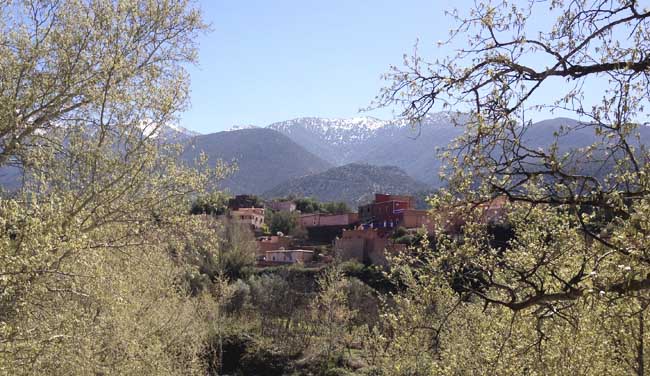
Up in the mountains, Berber villages, although they still cluster round tiny rutted lanes, include substantial houses with electricity, water, drainage and, of course, the ubiquitous statellite dishes. Everyone, children included, is relatively well dressed and the young men who stop you to chat (and, of course, offer you a guided tour) speak excellent English as well as French.
So, what was I doing here? Well, unashamadely escaping the somewhat frenzied activity of the last few months – and the rain! A few days outside Marrakech (an old haunt) followed by a few more up the Atlas mountains with the sole purpose of sitting in the sun and reading as many books as we could. I actually managed a book a day, rather to my satisfaction, especially since all were very much worth reading. For those who are interested, listed below!
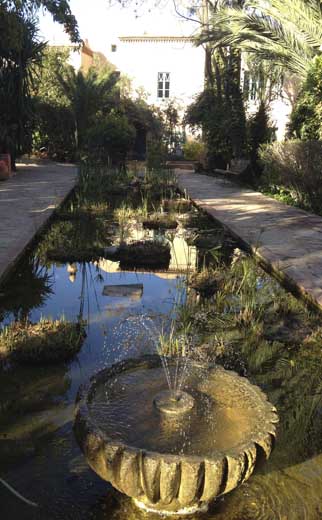 Our hostelry in Marrakech was in the very up-market Palmeraie development about 15 minutes out of town. Our hotel, Les Deux Tours, was built in the 1990s as an ‘Arab village’ – a series of inter-connecting, tree-filled courtyards surrounded by balconied rooms – but seriously upgraded a few years ago by architect Charles Boccara.
 The rooms are cool, spacious and beautifully tiled – and ours had the largest bed I have ever seen in a hotel. Forget king-size! This had two queen size beds linked together so that even touching hands from either side required a major stretch!
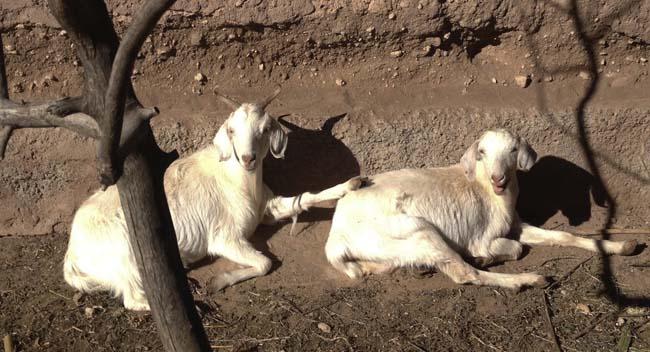
Shady paths skirting a profusion of tinkling pools linked the rooms to the hotel proper, the main swimming pool and the extensive ‘potager’ complete with: four very chatty goats, a random collection of hens, a bald headed turkey, a guinea fowl, ducks and rather disgruntled looking peacock.
The dining room was a brick vaulted cathedral, surrounded by Moorish ‘snugs’ nestling round a roaring log fire.The only thing really not-to-like enormously was the food. Not that it was bad. It absolutely wasn’t – but neither did it really live up to its surroundings, nor do justice to the hotel’s splendid potager!
The food at our second stop in the mountains shared Les Deux Tour’s reluctance to use vegetables although it was somewhat more interesting in terms of spicing. This hotel, La Rosaraie, has been around for over 40 years and its USP is its quite extraordinary rose gardens – not, sadly, in bloom in February. But what a site they must be in June!!
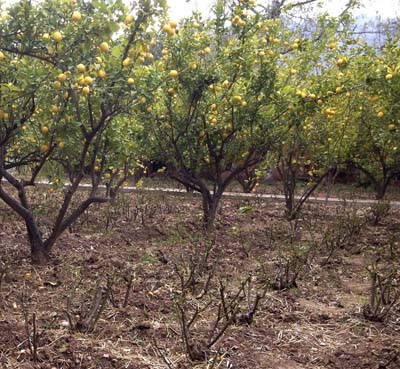 I have never seen so many roses, the vast majority, hybrid teas with all of the pruning that that involves. There must be at least 1500 spread over the really lovely mountain gardens – many literally in small fields underplanting the orange and lemon trees, others tucked in ever corner and cranny that was not already filled with cacti and palms.
Although the hotel is on the lower slopes of the mountains, the situation is lovely and incredibly peaceful at the bottom a valley with rather a sad little river (they are very short of rain) running through it. We did not take up the offers of guided trekking in the hills (would have eaten too heavily into book reading time) but we did go for a couple of hours wander each evening up into the rust coloured hills behind the hotel, covered in scrubby little pine trees, called arboravitae, and budding white iris!
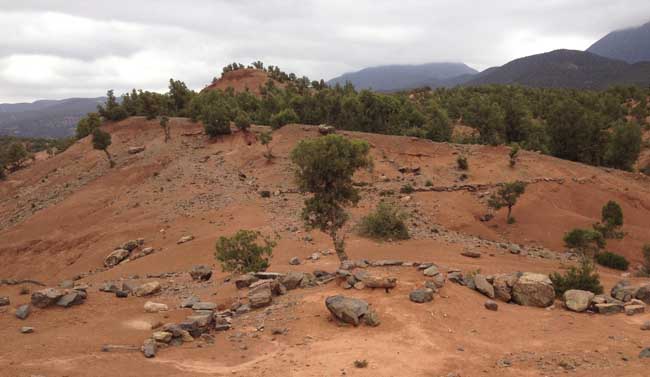
The hotel itself, although a little fusty and old fashioned, was extremely spacious and pleasant, with wonderful log fires in all rooms in the evenings, a profusion of swimming pools and ‘loungers – and the most delightful staff. The only slight blight on the landscape was the resevoir into which the river fed at the bottom of the valley.
To create it, the bottom of our valley, once a fertile farming and tourist area heavy with olive and apple trees, villages, hotels and lakeside restaurants, had been flooded and the villagers moved. This happens (although the collateral damage of some of the hydro-electrical schemes may sometimes outweigh the benefits) and Marrakech is now well supplied with water. The slightly odd thing is that having flooded the bottom of the valley, they now appear to have allowed the water levels to falls so far (as a result of string pulling by the remaining more influential villagers, as far as we could understand) that the bottom of the valley, now quite dry, resembles a blasted moonscape… Skeletons of trees, ruins of houses all poking up through red-brown dried sludge…. Anyhow, this is not visible from the hotel (which is more than can be said for an extremely large red and white mobile phone mast looming over the valley…) and only to be discovered if you go wandering down the river bed and then get chatting to one of the villagers.
 So, for anyone wanting a week in the sun in February – Morocco is the number! Sun in the day – but not too hot, brisk in the evening, but with lovely log fires, mad bustle and activity in Marrakech if you want it, glorious peace up the mountains if that is what you seek…
Our trip was every splendidly organised by Lawrence of Morocco – who have managed to so tame EasyJet for the benefit of their passengers that you and your ‘hold’ luggage are whisked through the last minute ‘speedy baggage’ check with not a murmur about pack sizes or extra costs – what joy!! I would most certainly use them again – next week, if I had the chance!!
And for those who are interested in our reading matter:
Morocco That Was – Walter Harris
A splendidly braggadaccio memoir of the adventures of the Times‘ correspondent in north Africa from the mid 1890s to 1912. Amazingly it seems that many of his tales, most involving the last sultans, were actually true.
The Shadow of the Sun – My African Life – Ryszard Kapuscinki
A fascinating series of essays covering the Polish journalist’s travels all over Africa from the 1960s to the end of the century. Often living in the poorest quarters, Kapuscinski delves deep into the African psyche, the African concept of time, of evil, of sin and of success.
The Grass is Singing – Doris Lessing
Doris Lessing’s first, and chilling, book about the psychological disintegration of a white couple on a failing hill farm in Southern Rhodesia in the 1940s.
A far cry from Kensington – Muriel Spark
Delightful, humourous but insightful tales of the occupants of a rooming house in South Kensington in the 1950s – before South Ken had moved up in the world to its current elevated position.
Stasiland – Anna Funder
Stories of those who worked for the Stasi and those whose lives were blighted (and sometimes ended) by them. Absolutely lived up to all the rave reviews.
Saplings – Noel Streatfield (Persephone Books)
How the Second World War, in the shape of a bomb that killed their father, destroyed the lives of a happy middle class family of children. Beautifully told from the children’s point of view.
Reuben Sachs – Amy Levy (Persephone Books)
A vivid portrait of successful middle class Jewish life in the 1880s/90s by a young Jewish authoress who committed suicide at the age of 27.
The Victoria City – Everyday Life In Dickens’ London – Judith Flanders
A joyful tome – if you like London, social history and Dickens! Splendidly researched and beautifully written, I was glued to every one of its 500 pages!